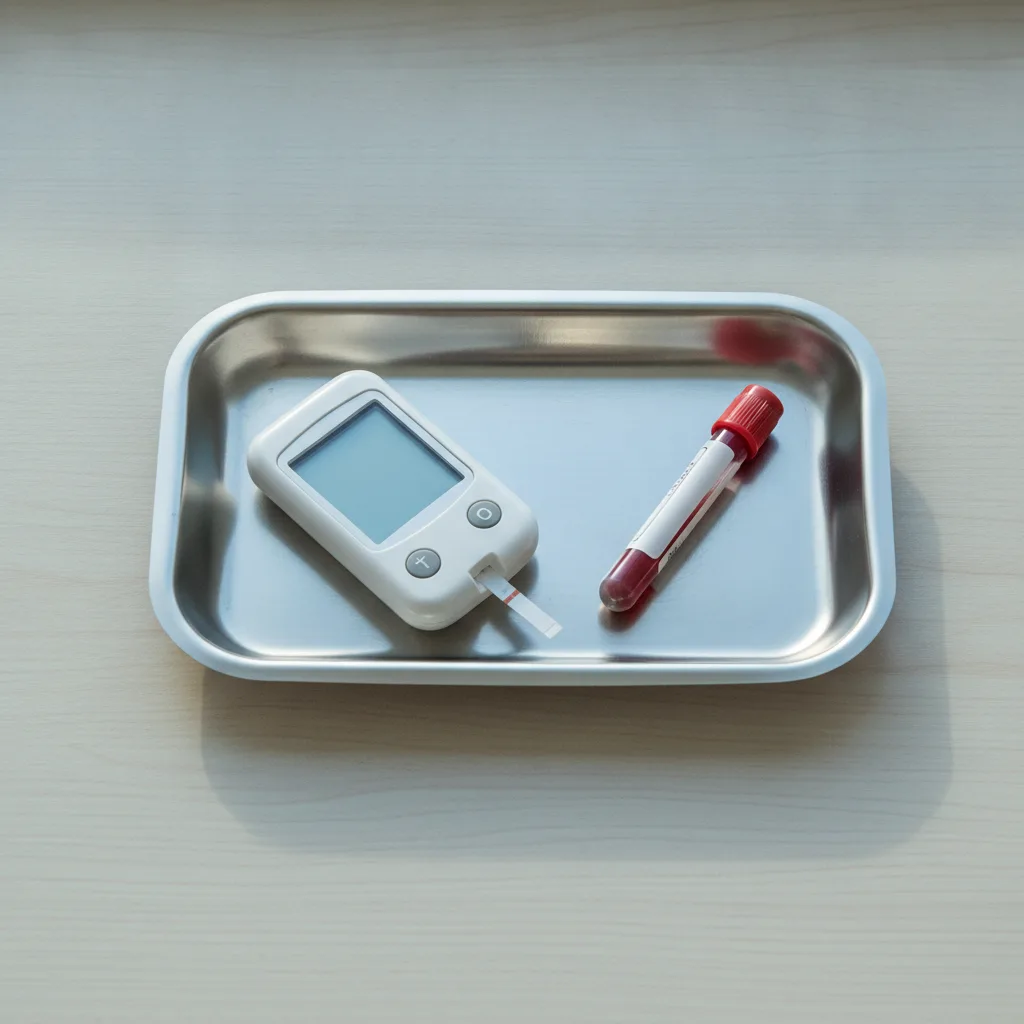
What insulin resistance is
Insulin is the hormone that moves glucose out of the bloodstream and into muscle, fat, and liver cells. Insulin resistance means those cells respond less effectively to the same amount of insulin. The pancreas compensates by producing more, and for years this compensation works: blood glucose stays normal while insulin levels climb quietly in the background.
The condition matters because compensation has limits. When the pancreas can no longer keep up, blood glucose rises — first into the range called prediabetes, then into type 2 diabetes. But the elevated insulin itself, long before glucose becomes abnormal, is associated with a cluster of problems: high triglycerides, low HDL cholesterol, elevated blood pressure, and a tendency to store fat around the abdomen. Together, these features define what clinicians call metabolic syndrome.
Insulin resistance is common, frequently undiagnosed, and — importantly — at least partly reversible. That reversibility is what makes it worth understanding.
Blood glucose is often the last number to move. Insulin resistance can be present for years while standard lab results still look normal.
The visceral fat connection
Not all body fat behaves the same way. Subcutaneous fat — the fat under the skin of the hips, thighs, and arms — is relatively metabolically quiet. Visceral fat, which surrounds the organs inside the abdominal cavity, is not. It releases free fatty acids directly into the portal circulation leading to the liver and secretes signaling molecules that interfere with insulin action.
This is why waist circumference predicts metabolic risk better than body weight alone. Two people with identical BMIs can have very different insulin sensitivity depending on where their fat is stored. The pattern sometimes called “TOFI” — thin outside, fat inside — describes people of normal weight who carry significant visceral fat and show the lab signature of insulin resistance.
The practical implication cuts both ways. Visceral fat is harmful, but it also responds relatively quickly to lifestyle change. Modest weight loss — in the range of 5 to 7 percent of body weight — disproportionately reduces visceral depots and can produce measurable improvements in insulin sensitivity before the scale has moved dramatically.
How insulin resistance is measured
There is no single routine test labeled “insulin resistance.” Clinicians and researchers infer it from a combination of markers, each with strengths and blind spots.
| Marker | What it reflects | Limitation |
|---|---|---|
| Fasting insulin | How hard the pancreas is working to keep glucose normal | No universal reference range; varies between assays |
| HOMA-IR | Calculated from fasting glucose and fasting insulin; estimates resistance | A research tool; cutoffs differ across populations |
| HbA1c | Average blood glucose over roughly three months | Rises late; normal values do not exclude resistance |
| Triglyceride-to-HDL ratio | Lipid pattern associated with insulin-resistant states | Indirect; influenced by diet, alcohol, and genetics |
HOMA-IR — the Homeostatic Model Assessment of Insulin Resistance — combines fasting glucose and fasting insulin into a single index and is the standard measure in research settings. Fasting insulin on its own is arguably the most informative single number in everyday practice, because it can be elevated for years while glucose and HbA1c remain normal.
HbA1c, by contrast, is a lagging indicator. It is essential for diagnosing prediabetes and diabetes, but a normal HbA1c does not rule out insulin resistance. The triglyceride-to-HDL ratio is a rough proxy: a high ratio tracks with the lipid pattern typical of insulin resistance, though it should never be read in isolation.
Anyone interpreting these numbers should do so with a physician, because reference ranges, medications, and individual context change what any given value means.
What the lifestyle evidence shows
The landmark trial in this field is the Diabetes Prevention Program (DPP), published by Knowler and colleagues in the New England Journal of Medicine in 2002. The trial randomized 3,234 adults with impaired glucose tolerance — people already on the path to diabetes — to one of three arms: an intensive lifestyle program, metformin, or placebo.
The lifestyle intervention targeted 7 percent weight loss and at least 150 minutes of moderate physical activity per week, supported by regular coaching. Over an average follow-up of about 2.8 years, the lifestyle group reduced the incidence of type 2 diabetes by 58 percent compared with placebo. Metformin reduced incidence by 31 percent. Lifestyle change, in other words, outperformed the drug — and the benefit was seen across age groups, sexes, and ethnic backgrounds.
Two details are worth underlining. First, the weight-loss target was modest: 7 percent, not a dramatic transformation. Second, the lifestyle arm was intensive, with structured support — a reminder that advice alone is not the intervention that was tested.
The DPP does not prove that lifestyle change fixes every case of insulin resistance, and later follow-up showed the risk reduction fades somewhat over time. But it remains the strongest evidence that the trajectory toward type 2 diabetes can be altered, and it anchors current prevention guidelines.
Sleep, movement, and daily rhythm
Beyond diet and formal exercise, two levers are consistently underestimated.
Sleep restriction impairs insulin sensitivity measurably, in controlled studies, within days. Short or fragmented sleep shifts hormones that regulate appetite and glucose handling, and chronic short sleep is associated with higher diabetes risk in observational cohorts. Most adults do best with seven to nine hours; treating sleep as optional is metabolically expensive.
Movement matters independently of structured workouts. Muscle contraction takes up glucose through pathways that do not require insulin at all, which is why even walking after meals blunts glucose excursions. Prolonged uninterrupted sitting, by contrast, is associated with worse metabolic markers even in people who exercise regularly. Breaking up sedentary time — standing, short walks, taking stairs — is not a substitute for exercise, but it is a meaningful complement.
Neither sleep nor step counts appear as dramatic interventions. Their value is that they are sustainable, and sustainability is what insulin resistance responds to.
When medication enters the picture
Lifestyle change is the foundation, but it is not always sufficient — and it is not a moral failing when it is not. Medication becomes a reasonable discussion when prediabetes progresses despite genuine lifestyle effort, when diabetes is diagnosed, or when cardiovascular risk factors cluster.
Metformin remains the typical first-line agent for type 2 diabetes and was the drug arm in the DPP. Newer classes — GLP-1 receptor agonists, dual GIP/GLP-1 agonists, and SGLT2 inhibitors — add substantial weight loss and, for some agents, proven cardiovascular benefit. These are prescription decisions that depend on individual history, kidney function, other medications, and cost.
The evidence-based framing is not “lifestyle or medication” but “lifestyle, plus medication when indicated.” Anyone concerned about their own metabolic markers should bring their lab results to a physician rather than self-interpreting a single number.
- Knowler WC, Barrett-Connor E, Fowler SE, et al.; Diabetes Prevention Program Research Group. Reduction in the incidence of type 2 diabetes with lifestyle intervention or metformin. N Engl J Med. 2002;346(6):393-403. doi:10.1056/NEJMoa012512